
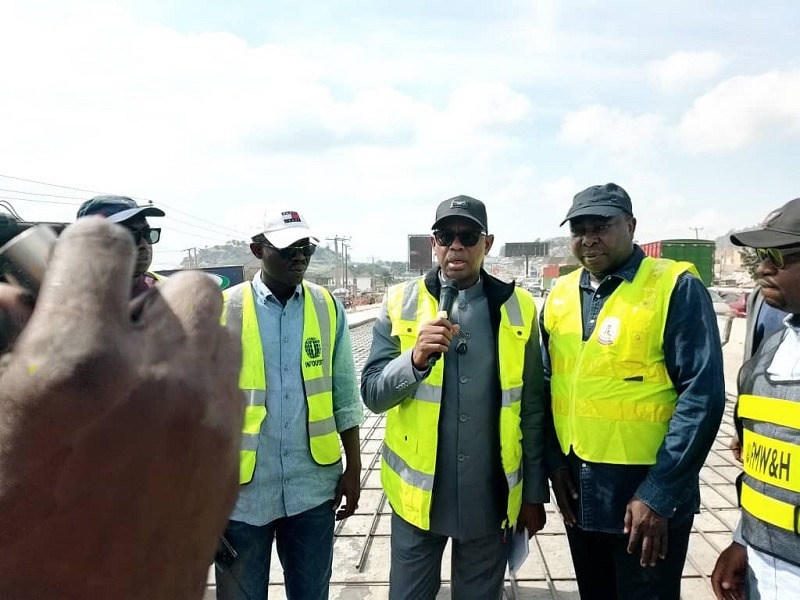
The Federal Government has raised alarm over the growing cases of vandalism and misuse of newly constructed and ongoing road projects across the country, warning that such acts threaten the durability and safety of key national infrastructure.
Minister of State for Works, Bello Goronyo, issued the warning on Saturday during an inspection of the ongoing Abuja–Kaduna–Zaria–Kano Expressway at Jere, where he condemned acts of sabotage and negligence by some residents along completed and active road corridors.
He expressed concern over reports of individuals damaging sections of completed roads, removing safety railings, and converting parts of highways into refuse dumps and drying grounds — particularly along the Jaji Bridge corridor in Kaduna State.
Describing the trend as alarming, Goronyo said some refuse collectors, popularly known as Mai Bola, have resorted to vandalising iron components of the concrete pavement.
Read Also: Brake failure claims lives of three LASUSTECH students in Lagos crash
“Maintenance means a lot. Preventing road abuse is part of maintenance. We have noticed people breaking newly completed roads or removing vital components overnight,” the Minister said. “Along the Jaji Bridge, for instance, some residents have tampered with structures to pass cables or place logs across the bridge. These are acts of vandalism that must stop.”

He urged traditional rulers, community leaders, and residents to take ownership of public infrastructure, warning that such destruction forces the government to divert funds meant for other vital services into repeated repairs.
“The government has invested huge resources in these projects, and we must protect them for the benefit of all,” he added.
Speaking further, Goronyo said the improved sections of the Abuja–Kaduna–Zaria–Kano road have already enhanced travel safety and reduced insecurity along previously volatile routes.
“The importance of well-maintained roads cannot be overemphasized. They enhance safety, reduce travel time, and improve security. We must work together to protect these national assets,” he stated.
Reaffirming the Tinubu administration’s commitment to completing the highway within schedule, the Minister described it as one of President Bola Tinubu’s flagship projects, designed to boost trade and strengthen national unity.
He noted that the 144-kilometre project, re-awarded to Infiouest International Ltd in March 2025, is progressing steadily across at least eight sections.
“The Minister of Works, David Umahi, has directed that contractors must be kept on their toes until the entire stretch is completed to specification. This project is dear to Mr. President’s heart because of its strategic importance to trade, national unity, and security,” Goronyo said.
He explained that the Abuja–Kaduna section, covering about 81 kilometres, is being built with rigid concrete pavement, while the Kano section — including the completed 6.6-kilometre airport road — is constructed with asphalt.
Construction, he added, is ongoing simultaneously in over ten locations, from Madalla and Jere to Katari, Kakau, Gonigora, and Agogo Junction, covering drainage, reinforcement, and shoulder works.
“So far, about 26 kilometres of continuous concrete pavement and 15 kilometres of binder and wearing courses have been completed,” he added.
Goronyo assured that funding will not delay the project, describing the highway as a critical national artery that will boost commerce, ease mobility, and improve security across northern Nigeria.
“The President has made it clear that funds will not stop this road. It’s now a matter of work and get paid. This commitment shows the administration’s seriousness about building infrastructure that truly serves Nigerians and stands the test of time,” he emphasized.

Engineer Musa, Director of Bridges and Design at the Ministry, noted that the road’s design was upgraded from flexible (asphalt) to rigid (concrete) pavement in line with the President’s directive for durable infrastructure.
“Most heavy-duty vehicles in Nigeria exceed axle load limits, and asphalt cannot withstand that stress. Rigid pavements are built to endure, with concrete designed to last over a century.
“This project is built like a bridge deck, with grade 40 concrete and reinforced steel spacing to ensure strength and durability.”
He added that a recycling approach is also being adopted, where milled asphalt is mixed with a stone base and cement to create a stronger substructure, thereby reducing costs and environmental impact.
Senior Project Manager for Infiouest, Robert Turner, confirmed the company’s commitment to meeting the government’s timeline.
“We are working seven days a week and may soon extend to night shifts to speed up progress. The government has been consistent with funding, and our goal is to deliver within the record time set by the Minister and the President,” he said.
He informed the Minister of the readiness of the company to fast-track the project by introducing night shifts, citing the heavy traffic along the route and their determination to complete the work even before the scheduled timeframe.