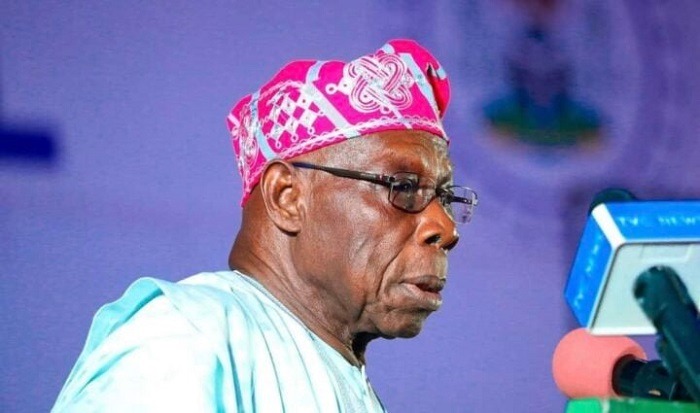
Former President Olusegun Obasanjo on Thursday said the assassination of former Head of State, General Murtala Mohammed, forced Nigeria’s military leadership to overhaul the country’s security architecture.
He said the tragedy exposed grave lapses in vigilance and underscored the need for institutional safeguards over personal loyalty.
Obasanjo spoke in Abuja at the Murtala Muhammed International Lecture and Leadership Conference themed, “Has Africa come of age?”, organised by the Murtala Muhammed Foundation.
“When Murtala was assassinated, I was there. There was nothing left for me in the military government. We had given our best,” he said.
“We had to look back and ask ourselves where we had gone wrong, and we realised there had been serious negligence in security. That shaped what we needed to do thereafter.”
Drawing from a Yoruba proverb, he added: “When a young man falls, he looks forward; when an elder falls, he looks back. We looked back, and that was how the issue of security was fundamentally rejigged.”
Obasanjo disclosed that some of the coup plotters were close to the late leader, including an aide and a colleague from the Defence College, a development he described as particularly painful.
He also recalled internal divisions within the Federal Government toward the end of the civil war, warning that the cracks nearly undermined the war effort.
Read Also: Dangote Refinery Hits Full 650,000bpd Capacity — MD
According to him, he returned from the war front to insist that Nigeria must first stabilise its political structure.
“We said, let us put our house in order first. Without reconstituting the political structure, effective command and accountability would have been impossible,” he said.
Reflecting on the coup that brought him and Murtala to power in 1975, Obasanjo described their administration as patriotic and mission-driven, anchored on discipline and modesty.
He cited Murtala’s simple lifestyle as emblematic of the era. “Murtala’s residence in Kano had no gates, and he rejected an official guest house because he felt it was over-furnished. What was considered excessive then would today be seen as modest,” he noted.
Obasanjo identified policy reversals by successive governments as a major setback for Nigeria and Africa, arguing that continuity in governance remains weak.
He said Murtala’s enduring legacy was not only his reforms but his ability to leave behind a successor who sustained his vision.
“The greatest achievement of Murtala was that he left behind a successor who could carry on after him. The failure of leaders after him, including myself, is that we have not been able to do the same,” he said.
He cited the lifting of the rice import ban after the 1979 transition to civilian rule as an example of how short-term political interests derailed long-term planning.
“Since that ban was lifted, we have not recovered. That is why we are still importing rice today,” he said.
Also speaking, a former President of Ghana said Africa’s journey toward unity, dignity and self-determination remains unfinished.
He argued that the question of whether Africa has come of age is not about the number of years since independence. “Africa is ancient in civilisation and wisdom,” he said.
Political freedom, he noted, is only the beginning of national maturity. The real test, he added, is whether the continent stands with a clear sense of identity, responsibility and purpose as a moral force in global affairs.
Recalling Murtala Mohammed’s 1975 declaration that “Africa has come of age,” he said the statement was a bold assertion of dignity, not triumphalism.
According to him, the late Nigerian leader insisted Africa would no longer be treated as “an object of history to be influenced, divided and directed by others,” but as a people capable of shaping their destiny.
He, however, lamented that the Pan-African fervour of the 1950s and 1960s has not fully translated into practical unity.
“For all the rhetoric of unity, we remain a diverse people of many languages, cultures and historical experiences,” he said, questioning the pace of regional integration efforts, including plans for a common West African currency.
He warned that although formal colonialism has ended, patterns of dependency persist.
Enslavement and colonial rule, he said, not only exploited resources but also distorted Africa’s psyche, leaving structures that still shape governance and economic relations.
Africa, he cautioned, risks becoming “once again, a reservoir for exploitation” amid emerging global rivalries between major powers.
He urged African nations to avoid being drawn into geopolitical contests, insisting the continent must not return to any “master-servant relationship.”
On the path forward, he stressed the central role of leadership and citizen empowerment.
“Leadership is the bridge between identity and destiny,” he said, adding that the character of leaders defines the humanity of institutions.
He emphasised, however, that empowered citizens are even more critical. “It’s people first before the leadership,” he declared.
Drawing from his experience as former Chair of the African Union and twice Chairman of ECOWAS, he urged Africa to engage the world “not in imitation but in dignity.”
According to him, the continent’s challenge is not a lack of resources but a failure to empower its people from the grassroots.
He also unveiled efforts to promote continental integration through an Africa Public Interest Media Initiative, aimed at leveraging digital technology and artificial intelligence to foster a shared African identity.
The initiative, he said, centres on the “African citizen” — one who retains national identity while belonging to a broader continental community entitled to dignity and rights.
By combining Africa’s storytelling traditions with modern technology, he added, the continent can advance the vision of a borderless Africa.
On whether Africa has truly come of age, he offered a nuanced view.
In one sense, he said, the continent can answer in the affirmative, having dismantled colonial rule. In another, Africa’s maturity remains a work in progress.
With Africa’s youth projected to account for about a quarter of the global population within the next two decades, he urged them to drive the next phase of development.
“Africa’s maturity must go beyond proclamation,” he said. “It must be demonstrated through the quality of our leadership, the integrity of our constitutions, and the humanity of our development.”