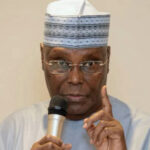

Former Vice President Atiku Abubakar has warned that the North risks prolonged stagnation and worsening insecurity unless its leaders urgently rebuild unity, reset priorities and confront the region’s mounting developmental challenges with honesty and resolve.
Speaking at the 25th anniversary dinner of the Arewa Consultative Forum (ACF) in Kaduna, Atiku praised the forum’s resilience “through thick and thin” over the last quarter-century but stressed that the moment calls for sober reflection and strategic action rather than nostalgia.
He paid tribute to past ACF leaders who, he said, “weathered enormous political and social storms” to keep the organisation alive, praying for the repose of their souls and urging current leaders to honour their legacy.
Read Also: Targeting of schools by bandits poses grave danger to Nigeria’s educational system – Rep Garba
Recalling his early days as Vice President in 1999, Atiku said the North at the time was sharply divided along political lines. One of his first assignments, he noted, was to mobilise leaders across the region to forge a common front. That effort, after extensive consultations, produced a reconciliation committee led by the Emir of Ilorin, Ibrahim Sulu-Gambari, which ultimately paved the way for the founding of the ACF. Despite the difficulties, he said, the merger succeeded under the stewardship of former Head of State General Yakubu Gowon and the late M.D. Yusufu.
Atiku emphasised that the ACF was created not just for political cohesion but to champion development in line with the vision of the late Sir Ahmadu Bello. He reminded the audience that the Sardauna’s priorities—education, agriculture and industrial development—remain critical to the North’s progress.
Quoting from Ahmadu Bello’s 1961 address on agricultural expansion, soil conservation, livestock improvement and the need to create conditions for education and industry to thrive, Atiku said these goals took on renewed urgency by 1999. This led him to initiate the Northern Education Project, headed by Prof. Adamu Baiki, to diagnose and address decline in the region’s education system. He said the findings were alarming, prompting reforms in teacher inspection, capacity-building, and restoring dignity to the teaching profession. According to him, enrolment and transition rates doubled in several states by the end of the administration’s first term.
He also cited the Northern Development Project (NDP), which sought to reform agriculture by rebuilding value chains, reviewing policies and confronting climate-related threats to productivity. On industry, Atiku said a survey exposed long-standing bottlenecks—energy shortages, financing gaps, raw material deficits and multiple taxation—issues he lamented still persist today.
He said revisiting these past efforts was not an exercise in nostalgia but a call to “wake the North from complacency” and underscore the urgency of building on earlier foundations.
Turning to unity, he warned that diversity was increasingly being weaponised by adversaries who exploit fear, technology and disinformation to deepen divisions and target the region’s resources. He urged the North to learn from multiethnic nations like India and China, which have achieved economic transformation despite far greater diversity.
He also referenced Ahmadu Bello’s 1960 speech in Los Angeles, where the Sardauna described diversity as a strength and cautioned against those who “set tribe against tribe, Christian against Muslim.”
Atiku raised fundamental questions about the region’s future—population growth, food security, education, job creation and readiness for a knowledge-driven global economy. He warned that the 21st century “will not tolerate complacency, absentee leadership or leadership without vision.”
As he rounded off, Atiku urged Northern leaders to reflect on the kind of legacy they want to leave behind—“as those who sacrificed for their people or those who only buttered their bread.” He called for renewed unity, insisting that if ever there was a time for the North to come together, “that time is now.”
He prayed for God’s guidance as the region confronts its numerous challenges and commended the ACF for its enduring role in shaping northern consciousness.