
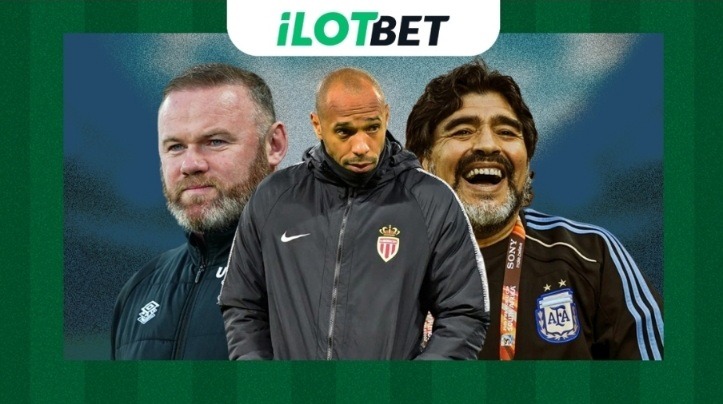
There is a comforting assumption in football that greatness should be transferable. If a player could see angles no one else noticed, execute skills others could only imagine, and dominate matches at the highest level, surely that knowledge should flow naturally into coaching.
Yet football history repeatedly undermines this logic. Some of the game’s most gifted icons have struggled badly in the dugout, while figures with modest playing careers have risen to define modern coaching excellence. The paradox is striking, and it raises a deeper question about what football intelligence really is — and whether it can ever be taught.
At first glance, the failures are surprising. Legends such as Diego Maradona, Thierry Henry, and Wayne Rooney entered coaching with immense credibility. Dressing rooms listened. Media attention followed. Expectations soared. But authority and understanding are not the same thing. Many great players discover, often painfully, that what came instinctively to them is almost impossible to explain to others. Football genius, when it is intuitive rather than analytical, resists translation.
This is where the first fault line appears. Elite players often operate on subconscious processing — decisions made in fractions of a second, shaped by talent, repetition, and natural feel. When they later tell players to “just see the pass” or “know when to arrive in the box,” the advice can sound vague or even dismissive. Coaching, by contrast, requires breaking football down into teachable components: spacing, triggers, automatisms, and collective behaviours. Many legendary players have never needed to consciously deconstruct the game, and when asked to do so, they struggle.
Closely linked to this is the issue of empathy. Great players often lived in a different footballing reality from their squads. They trained among elites, competed with the best, and solved problems with exceptional ability. When coaching average professionals, frustration can set in. Expectations become unrealistic. The coach assumes players should see what he once saw, move as he once moved, and react as he once reacted. This gap in lived experience can quietly erode communication and trust, turning dressing rooms tense rather than inspired.
Read Also: LSSC, UNILAG Open Strategy Discussion as Lagos Prepares to Host National Intermediate Games for Under-18
By contrast, many of football’s most successful coaches were never stars. Pep Guardiola was a fine player, but not a global icon in the way Lionel Messi would later become. José Mourinho barely played at elite level at all. What they possessed instead was an obsessive relationship with learning. They studied the game from the outside, analysing patterns rather than relying on instinct. Their authority came not from reputation, but from clarity of ideas and the ability to communicate them with precision.
This distinction explains why the few great players who succeed as coaches tend to share certain traits. Zinedine Zidane and Carlo Ancelotti — himself a highly decorated player — stand out not because they impose genius, but because they simplify it. Zidane, who won three UEFA Champions League in a row, rarely overwhelms players with theory. Instead, he manages personalities, creates balance, and allows talent to express itself within a stable structure. His success suggests that emotional intelligence and man-management can sometimes outweigh tactical complexity.
The modern game has also made coaching more demanding than ever. Data analytics, sports science, opposition analysis, and tactical specialisation now dominate elite football. A famous past offers no shortcuts here. Coaches are expected to explain not just what to do, but why to do it, how often, and under what conditions. Those who enter management believing their playing reputation will carry them quickly discover that football has little patience for nostalgia.
Ultimately, the difficulty for football greats lies in a cruel irony. The very qualities that made them exceptional — instinct, individuality, and effortless execution — are often the hardest to teach. Coaching rewards clarity over brilliance, patience over inspiration, and structure over spontaneity. Great players can succeed as coaches, but only when they accept that genius must be translated, not assumed.
In football, as in life, mastery of a craft does not automatically confer mastery of teaching it. And that may be why the touchline, not the pitch, remains the most unforgiving arena of all.
To test your own understanding of the game beyond reputation and hype, explore smarter football insights and predictions on iLOTBET.