
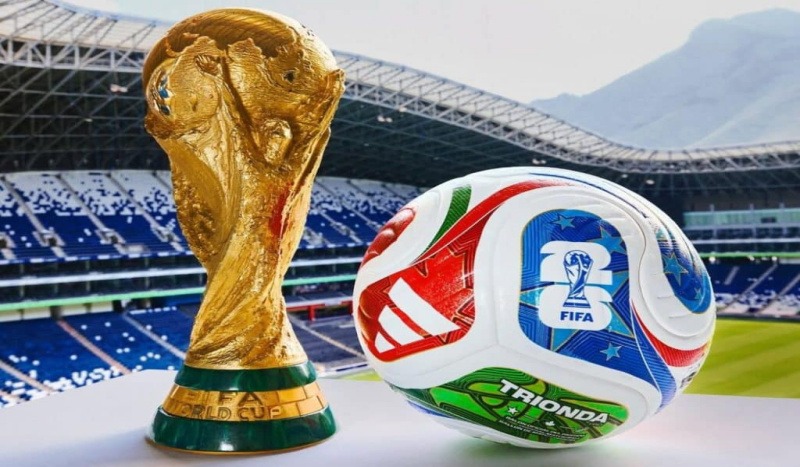
The 2026 FIFA World Cup kicks off today with hosts Mexico taking on South Africa at the iconic Estadio Azteca in Mexico City, but Nigeria will once again be absent from football’s biggest stage.
It is the second consecutive World Cup the Super Eagles have failed to qualify for, extending the disappointment among Nigerian football fans as the global showpiece gets underway.
This year’s tournament marks a historic milestone for the competition. For the first time, 48 nations will participate in a World Cup jointly hosted by three countries — the United States, Mexico and Canada.
Spanning multiple cities, time zones and climatic conditions, the expanded tournament is expected to be the biggest in FIFA history, bringing together teams from across the globe in an unprecedented celebration of football.
FIFA has described the competition as a landmark event that will reshape the sporting landscape, from the opening match in Mexico City to the final scheduled for July 19 at the New York/New Jersey Stadium.
Beyond the excitement of the expanded format, the tournament also reflects the changing dynamics of global football, with emerging nations earning opportunities on the world stage even as some traditional powers and former regular participants miss out.
For Nigeria, however, the focus will remain on rebuilding and ensuring a return to the World Cup after successive qualification failures.
When FIFA decided to expand the World Cup from 32 to 48 teams, critics immediately decried a dilution of quality. What cannot be denied, however, is the sheer grandeur of the logistical blueprint. Spanning 16 cities, the tournament features a revamped format: 12 groups of four teams each, leading to an entirely new knockout phase — the Round of 32. That extends the schedule to a gruelling 104 matches.
FIFA President Gianni Infantino captured the vision behind the expansion, saying the tournament is about making football truly global, giving millions more fans a reason to dream and creating an inclusive environment that celebrates unity through diversity across three nations.
Competing teams will have to navigate extensive travel requirements, moving from the high altitude of Mexico City to the humid summers of Miami or the cooler Pacific winds of Vancouver. Squad depth and sports science will be tested like never before, with a group stage lasting an uninterrupted, high-octane 17 days.
African continental harvest sans the giants
For African football, the expansion is nothing short of a revolution. For decades, the Confederation of African Football fought against a restricted quota system that left world-class talent at home through the narrow bottleneck of five qualification slots.
This time, history is made as Africa sends an unprecedented 10 teams to the global stage: Morocco, Senegal, Egypt, Côte d’Ivoire, Tunisia, Algeria, Ghana, DR Congo, South Africa and Cape Verde.
Yet this historic moment carries an undeniable undercurrent of shock. Africa’s traditional powerhouses — including Nigeria’s Super Eagles and Cameroon’s Indomitable Lions — failed to survive the gruelling qualification campaign. Following the Super Eagles’ heart-breaking penalty shoot-out elimination against DR Congo in the play-off final, the Nigeria Football Federation encapsulated the national mood, stating: “For a nation where the Super Eagles serve as a symbol of unity, hope and collective pride, missing out on the World Cup is a disappointment of great weight and emotional depth. Football in Nigeria is a national language and a powerful symbol of unity that binds over 200 million people as one family.”
The failure has sparked widespread debate about administrative discipline and coaching consistency on the continent, proving that the competitive landscape in Africa has flattened and previously unheralded teams have closed the gap on the old guard.
Stars in the spotlight and the tragic absences
A World Cup is ultimately defined by the virtuosos who grace its pitches. The 2026 edition features a captivating blend of veteran legends chasing final glory and a hungry vanguard of youthful superstars. France’s Kylian Mbappé arrives at the peak of his powers, eager to make amends for the heartbreak of the 2022 final in Qatar, while England’s Jude Bellingham represents the modern, complete midfielder capable of carrying historical expectations. Brazil will lean heavily on the trickery of Vinícius Júnior, and Erling Haaland makes his long-awaited World Cup debut with Norway in a brutal group that also features France and Senegal. Spain will count on the mercurial Lamine Yamal, while Ghana will look to Manchester City striker Antoine Semenyo who shone in his final Premier League season at Bournemouth before his high-profile move to City, to sparkle on the biggest stage.
For Nigerian fans, scanning these rosters brings a sharp twinge of regret. The tournament will be without the explosive brilliance of Victor Osimhen, one of the most feared strikers in world football, the creative industry of Ademola Lookman and the blistering pace of Alex Iwobi. Their absence strips the tournament of a generation of Nigerian stars currently dominating club football across Europe.
Shadows over visas, bans and outbreak
The build-up to this tournament has been plagued by significant geopolitical, administrative and medical controversies that highlight the frictions of global hosting.
The most explosive controversy erupted on the eve of the tournament when Omar Abdulkadir Artan — Africa’s Best Male Referee in 2025 and set to become the first Somali official to referee at a World Cup — was denied entry into the United States after being detained for 11 hours at Miami airport over strict vetting concerns. A US State Department official defended the decision, stating that Artan “was determined to be inadmissible due to vetting concerns and specific associations with suspected members of terrorist organisations,” and emphasising the need to balance hosting a global tournament with national security imperatives. The ruling provoked outrage within the African football community, though Artan himself showed immense grace, saying he remains in a positive mood, focused on the future and grateful to FIFA and CAF for their support. Support staffs from the Iranian national team were also denied US visas, forcing a relocation of their training base to Mexico, while Iraqi star striker Ayman Hussein faced several hours of detention at Chicago’s O’Hare airport before being cleared.
On the health front, a major Ebola outbreak in north-eastern Democratic Republic of Congo caused widespread panic, prompting the Leopards to conclude their disrupted World Cup warm-up campaign with a 2-1 defeat by Chile in a behind-closed-doors friendly in Orléans. The match was relocated to the French city after authorities in Cádiz, the original host venue, withdrew citing public health concerns linked to the outbreak.
Can Morocco replicate the magic of Qatar 2022?
In 2022, Morocco shattered the ultimate glass ceiling of African football by becoming the first team from the continent to reach a World Cup semi-final. In 2026, the question is no longer whether an African team can compete — it is whether one can go all the way.
Morocco remain Africa’s brightest hope, though their group-stage draw is unforgiving, placing them alongside Brazil. Senegal, the reigning giants of West African football, possess a highly balanced squad but face a daunting test against a star-studded France. For teams such as South Africa, who face Mexico today in the tournament opener, the primary objective will be navigating the expanded format to reach the Round of 32. With 10 African nations in the mix, the probability of at least one reaching the deep knockout stages is higher than ever — though the structural hurdles remain immense.
Likely winner
Predicting the winner of a 48-team tournament is an exercise in volatility. The sheer volume of matches means squad depth, tactical adaptability and logistical recovery will matter as much as individual brilliance. France and Argentina remain the standard-bearers: Argentina carry deeply ingrained tournament muscle memory, while France boast unparalleled squad depth across every position. The United States, playing on home soil with a golden generation of talent, could leverage the crowd to mount a deep knockout run.
The smart money, however, is on Brazil. Eager to end a 24-year World Cup drought, the Seleção have built a squad that perfectly balances defensive grit with the devastating transitional speed of Vinícius Júnior and Rodrygo. In a tournament defined by vast distances and gruelling travel schedules, Brazil’s ability to control tempo should prove decisive, and they are tipped to lift a record sixth crown in New Jersey. Portugal, with Cristiano Ronaldo leading the charge, are another side capable of upsetting the hierarchy.
The great experiment begins
As the first ball is kicked today, the administrative friction, visa denials and medical anxieties will temporarily recede, replaced by global frenzy.
The expansive 2026 World Cup is a massive gamble by FIFA. Whether it will be remembered as a logistical masterpiece or an over-bloated marathon remains to be seen.
One fact, however, is beyond dispute: the world is watching and the drama will be spectacular.