
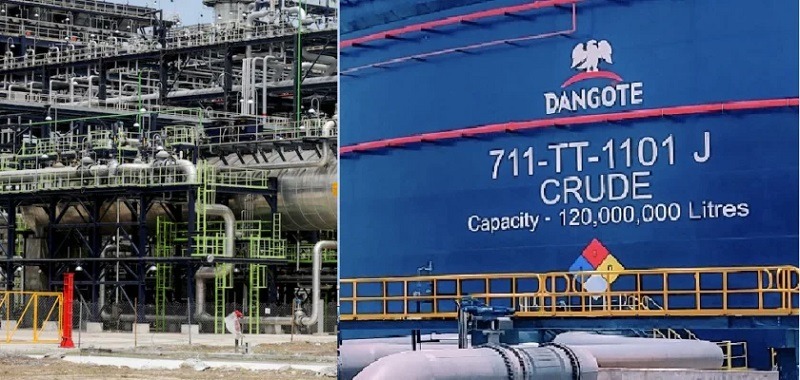
The Dangote Petroleum Refinery has announced a reduction in the gantry price of Premium Motor Spirit (PMS), popularly known as petrol, from ₦877 to ₦828 per litre — a 5.6 per cent decrease.
The price cut comes despite a recent uptick in crude oil prices, which rose to an average of $64 per barrel on Thursday from $62 the previous day.
Sources attributed the reduction to a strengthened crude oil supply agreement between Dangote Refinery and the Nigerian National Petroleum Company Limited (NNPC Ltd) under the naira-for-crude framework.
Under the new arrangement, NNPC Ltd will supply the 650,000 barrels-per-day refinery with five December-loading crude shipments, including Amenam, Bonny Light, Forcados, and Qua Iboe grades.
Read Also: Customs intercept 60,000 litres of diverted petrol in Katsina
Also, the Petroleumprice.ng, stated: “The price adjustment is expected to bring some relief to fuel marketers and consumers nationwide, following weeks of elevated pump prices. Depot operators in Lagos confirmed that loading at the new price commenced early Friday, with expectations of a corresponding drop at retail outlets in the coming days.”
Meanwhile, the price remains below import parity, according to the report by S&P Global Commodity Insights presented at the Major Energy Marketers Association of Nigeria (MEMAN) conference in Lagos on Thursday.
According to the report, Dangote’s gantry price stood at N877 per litre as of October 17, 2025, placing it below the average “into-tank” cost of imported fuel in Lagos and the ship-to-ship (STS) value at Lome, Togo.
It noted that the pricing gap underscores Dangote’s cost advantage in the domestic market, even as international crude prices fluctuate amid sanctions on Russian oil producers and weak global demand.
The report also has it that the nation’s fuel imports have fallen below 200,000 barrels per day from about 500,000 b/d in early 2023.
However, S&P Global warned that strong regulatory oversight remains crucial to ensure market transparency, fair competition, and consumer protection in a liberalized environment.
The report, which highlighted operational challenges the domestic refineries, adding that Nigeria’s downstream transition, marked by deregulated pricing, falling imports, and new refining capacity.