
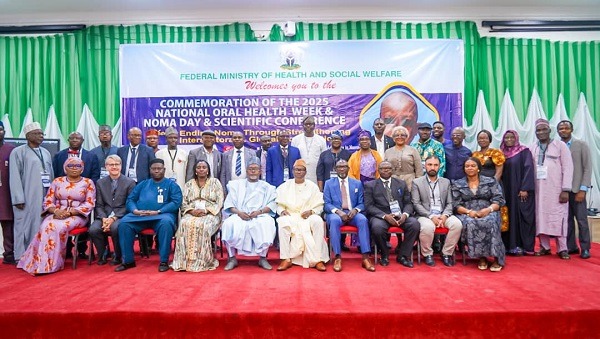
The Federal Government has restated its commitment to strengthen oral healthcare nationwide through updated legislation, expanded workforce training and tighter institutional coordination, as part of efforts to curb Nigeria’s high burden of preventable oral diseases.
Minister of State for Health and Social Welfare, Dr. Adekunle Salako, said government is upgrading dental facilities across the country and recruiting more dental professionals at the primary healthcare level to broaden access. Community health workers, PHC staff and traditional birth attendants, he added, are also receiving training to identify and refer cases of noma, cleft lip, cleft palate and other severe oral conditions for timely, often free, treatment.
Salako said the integration of oral health into the primary healthcare system would require PHCs to provide oral hygiene education, counselling, basic diagnostics, fluoride application, restorative services and referrals. He noted that the ongoing reorganisation of the Basic Health Care Provision Fund (BHCPF) will channel more resources to oral healthcare, particularly for vulnerable groups.
Speaking in Abuja on Tuesday at the 2025 National Oral Health Week and Noma Awareness Day, the minister warned that millions of Nigerians—especially children and the elderly—continue to suffer from preventable conditions such as dental caries, periodontal disease and oral cancers, which impair dignity, productivity and quality of life.
He described noma as one of the most devastating of these conditions, calling it a rapidly progressing gangrenous disease that strikes mainly malnourished children in extreme poverty. “Every Nigerian needs access to dental services,” he said, emphasising the need for greater awareness, improved oral-health literacy and the deployment of modern technologies to strengthen service delivery.
Read Also: Senate to screen ex-CDS Christopher Musa as Defence Minister — Senate Leader
Salako called for a whole-of-society response, linking efforts to eliminate noma and other oral diseases to improved nutrition, sanitation, housing, immunisation, and maternal and child health. “Noma is not just a medical failure but a societal inadequacy,” he said.
Permanent Secretary in the Ministry, Daju Kachollom, said noma remains preventable but devastating, and tackling it demands more than clinical intervention. She stressed that improved nutrition, clean water and sanitation, social safety nets and community empowerment must work alongside oral-health services to stop new cases and reduce mortality.
Kachollom highlighted Nigeria’s key role in securing the WHO’s recognition of noma as a Neglected Tropical Disease in 2023, describing it as a milestone that has helped mobilise global attention, funding, and research.
She reaffirmed the Ministry’s commitment to strengthening workforce capacity and ensuring oral-health services are accessible, affordable, and sustainable.
Chairman of the Noma Aid Nigeria Initiative (NANI), Mathis Winkler, described Nigeria as the most affected country in Africa and said this reality makes it essential for international partners to concentrate their efforts locally.
He said the initiative’s mission is to treat survivors and prevent new cases through awareness, early detection, and community-based interventions.
Winkler noted that NANI has been instrumental in establishing and operating specialised noma treatment programmes, including the Noma Treatment Center at the National Hospital, Abuja, where survivors receive surgical reconstruction, psychological support, nutritional rehabilitation, and follow-up care.
He said the organisation focuses on early identification of at-risk children, strengthening local medical capacity, and raising awareness of noma as a preventable disease, while working with communities to address root causes such as malnutrition and poor sanitation.
“We are here to treat, support, and prevent. And as long as Noma still affects children in Nigeria, we will continue this work,” he said.
NANI Country Director, Dr Charles Ononiwu, revealed that the centre has carried out 237 free reconstructive surgeries in its mission to address a disease that overwhelmingly affects children in rural and impoverished communities.
He expressed optimism about Nigeria’s recent progress, attributing improvements to increased awareness, stronger government support, and enhanced focus on neglected tropical diseases.
Ononiwu reiterated that Noma is highly preventable, noting that proper nutrition, good oral hygiene, early treatment of mouth sores, and routine childhood immunisation can significantly reduce its occurrence.