
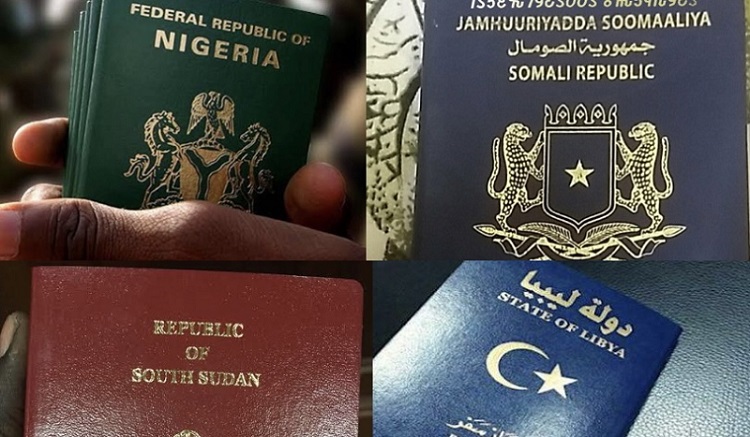
Across Africa, significant disparities persist in global mobility, with only a handful of countries enjoying relatively strong passports that offer broader access to international destinations.
However, many African nations continue to rank among the weakest in global passport indices, limiting the ease of movement for their citizens and restricting international travel opportunities.
The latest rankings from the Henley & Partners Passport Index indicate that conflict, political instability, weak diplomatic relations and security concerns remain key factors shaping passport strength across the continent. Citizens from countries affected by prolonged unrest or international isolation continue to face stringent visa requirements and lengthy approval processes when travelling abroad.
Here are Africa’s 10 weakest passports in 2026.
1. Somalia
Visa-free or visa-on-arrival access: 33 countries
Somalia has the weakest passport in Africa. Years of conflict, insecurity, and political instability have significantly limited its diplomatic reach and global mobility. Holders of Somali passports often undergo strict visa requirements and intensive screening before international travel.
2. Libya and Eritrea
Visa-free or visa-on-arrival access: 39 countries
Libya and Eritrea share second place. Libya’s passport strength continues to suffer from prolonged political instability and security challenges. Eritrea remains one of the world’s most isolated countries, with limited diplomatic engagement and tight state controls affecting travel opportunities for its citizens.
3. Sudan
Visa-free or visa-on-arrival access: 41 countries
Sudan ranks third on the list. Despite efforts to rebuild international relations, ongoing conflict and political uncertainty continue to weaken global mobility for Sudanese passport holders.
4. South Sudan and Democratic Republic of the Congo
Visa-free or visa-on-arrival access: 43 countries
South Sudan and the Democratic Republic of the Congo (DRC) share fourth position. Both countries continue to face insecurity, armed conflict, and governance challenges that have strained diplomatic relations and restricted international travel access.
Read Also: PHOTOS: Atiku meets Amaechi after ADC presidential primary
5. Nigeria and Ethiopia
Visa-free or visa-on-arrival access: 44 countries
Despite their status as major African economies, Nigeria and Ethiopia still rank among countries with relatively weak passports. Security concerns, migration pressures, and strict visa regimes from many developed nations continue to limit global mobility for their citizens.
6. Djibouti
Visa-free or visa-on-arrival access: 47 countries
Djibouti’s passport offers slightly better mobility compared to several peers. Its strategic location in the Horn of Africa and active international partnerships provide some advantage, though overall global access remains limited.
7. Republic of the Congo, Cameroon and Angola
Visa-free or visa-on-arrival access: 48 countries
These three countries are tied in seventh place. While regional integration within Africa has improved movement across neighbouring states, access to Europe, North America, and parts of Asia remains highly restricted.
8. Liberia and Burundi
Visa-free or visa-on-arrival access: 50 countries
Liberia and Burundi remain among Africa’s weakest passports. Limited diplomatic influence, governance constraints, and economic challenges continue to hinder their citizens’ global mobility.
9. Egypt and Central African Republic
Visa-free or visa-on-arrival access: 51 countries
Egypt, despite being a major regional power, still faces visa restrictions in several key destinations, including parts of Europe and North America. The Central African Republic continues to struggle with instability, which affects its international standing.
10. Chad
Visa-free or visa-on-arrival access: 52 countries
Chad completes the list. Ongoing security concerns in the Sahel and limited diplomatic reach have contributed to its low ranking on global passport indices.