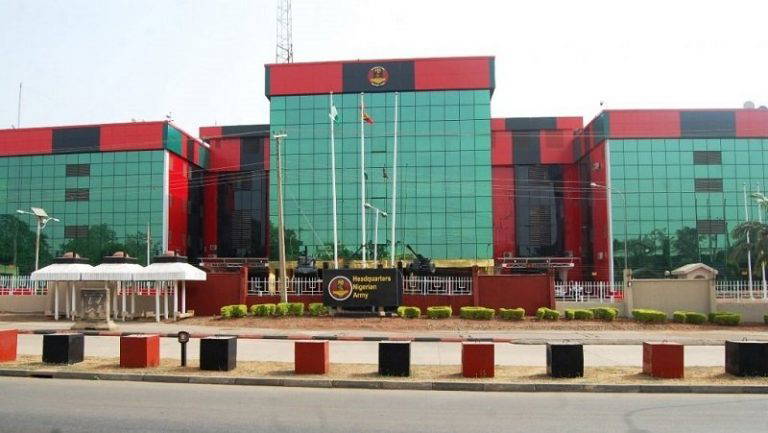
The Defence Headquarters (DHQ) on Tuesday dismissed claims that repentant Boko Haram members and other former insurgents were being recruited into the Nigerian military.
The DHQ emphasised that individuals with criminal records are legally barred from joining the armed forces and other security agencies in the country.
The military also rejected social media reports suggesting that troops provided cover for the Palm Sunday attack on Angwan Rukuba in Jos North Local Government Area of Plateau State, describing the claims as false and misleading.
During a virtual engagement on X Spaces, the Coordinator of Operation Safe Corridor, Brig.-Gen. Yusuf Ali, said the military’s deradicalisation programme for surrendered insurgents is strictly a rehabilitation initiative, not a recruitment channel.
“Once you have any criminal record, you cannot join the military or any security agency,” Ali said.
He explained that Operation Safe Corridor, introduced between 2015 and 2016 at the height of the North-East insurgency, was designed to manage surrendered fighters, particularly those coerced into joining terrorist groups, through structured rehabilitation and reintegration into civilian life.
According to him, participants underwent a multi-agency screening process involving the Ministry of Justice and other government and international partners before classification into low, medium and high risk categories.
READ ALSO: Bauchi governor signals possible PDP exit, opens talks with ADC
“Only the low-risk group can be admitted into Operation Safe Corridor for rehabilitation; these are individuals the justice system has determined have no case to answer,” he said.
Read Also: Insecurity: Defence Minister orders shoot-on-sight, deploys new strategies in North-east
Ali added that the programme provides deradicalisation support, trauma counselling and vocational training such as tailoring, carpentry and farming to enable beneficiaries reintegrate productively into society.
He stressed that hardened fighters captured during operations are prosecuted in accordance with the law.
“The programme operates on a dual-track system: criminal justice for offenders and rehabilitation and reintegration for victims,” he said, adding that Operation Safe Corridor “is about rehabilitation, not recruitment.”
He further noted that reintegrated former insurgents cannot return to terrorist groups because they are often perceived as informants and risk being killed.
“They will be killed. The high-risk terrorists believe they are now government spies and will sell them out,” he said.
Meanwhile, the Joint Task Force (JTF) Operation Enduring Peace in Plateau State dismissed allegations that troops provided cover for attackers responsible for the Palm Sunday killings in Angwan Rukuba community.
In a statement issued by the taskforce’s Media Information Officer, Capt. Chinonso Oteh, the military said troops responded promptly after receiving a distress call but found that the attackers had fled.
“At no point did troops provide any form of cover for the terrorist elements who carried out the unfortunate attack,” the statement said.
It added that four gun trucks were immediately deployed to the scene and that troops acted professionally to prevent further escalation of violence, a position corroborated by other security agencies and eyewitnesses.
The task force said an investigation confirmed the allegation by a community youth leader circulating on social media to be unfounded and warned that such claims could undermine troop morale and weaken cooperation between security forces and local communities.
“The public is requested to discountenance the comment, remain calm and continue to support troops with credible and actionable information,” the statement said.
It assured residents that troops, in collaboration with other security agencies, were pursuing strategies to apprehend those responsible for the attack and restore peace in the area.