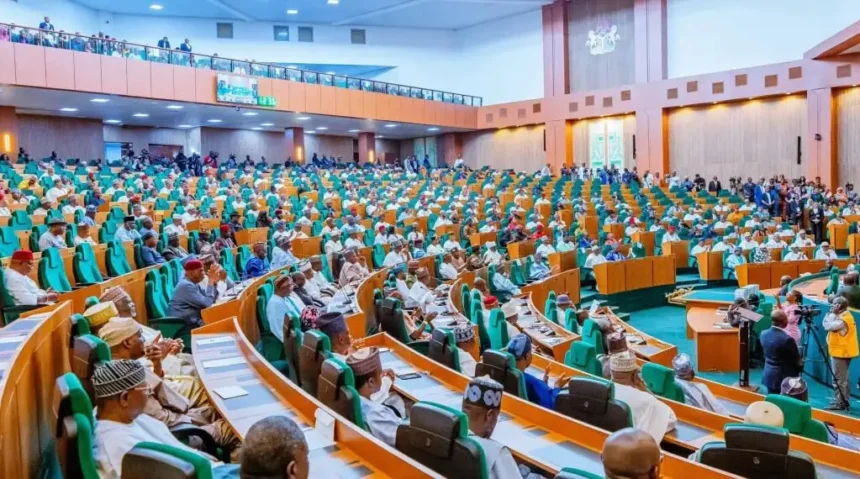
The House of Representatives on Thursday approved the 2026–2028 Medium Term Expenditure Framework (MTEF) and Fiscal Strategy Paper (FSP), setting the stage for the nation’s three-year budget planning.
The framework projects a total expenditure of N54.46 trillion in 2026, with N31.83 trillion representing the Federal Government’s retained revenue. The approval followed consideration of the report of the Committees on Finance and National Planning and Economic Development, presented by House Finance Committee Chairman, Hon. James Abiodun Faleke, during plenary.
The MTEF/FSP outlines the federal government’s revenue and spending projections over a three-year horizon, providing the basis for the annual budget.
New borrowings are projected at N20.38 trillion, encompassing both domestic and foreign sources, while debt service obligations are estimated at N15.52 trillion. Pensions, gratuities, and retirees’ benefits are pegged at N1.376 trillion, with the fiscal deficit projected at N22.63 trillion.
Read Also: Shettima pledges continued FG power sector reforms as NDPHC marks 20 years
The House also approved benchmark crude oil prices of US$64.85, US$64.30, and US$65.50 per barrel for 2026, 2027, and 2028, respectively. Domestic crude oil production is projected at 1.84 mbpd, 1.88 mbpd, and 1.92 mbpd over the same period.
Projected exchange rates for the three years stand at N1,512, N1,432.15, and N1,383.18 to the dollar, with the House urging alignment with the Central Bank of Nigeria’s policy to stabilise the naira and ensure fiscal-monetary coordination.
Inflation is forecast at 16.5% in 2026, 13% in 2027, and 9% in 2028, reflecting the Central Bank’s commitment to moderating price pressures. Gross Domestic Product (GDP) growth is projected at 4.68%, 5.96%, and 7.9% for the respective years, with the House calling for sustained reforms to realise these targets.
Emphasising the role of tax reforms in economic growth, the House urged full implementation of the new Tax Acts and recommended the adoption of a National Scanning Policy within the National Single Window of the Nigeria Revenue Service. The initiative aims to improve revenue assurance, enhance trade facilitation, reduce leakages, and strengthen transparency and national security.
Capital expenditure (excluding transfers) is projected at N20.131 trillion, with statutory transfers at N3.152 trillion and a sinking fund of N388.54 billion. Total recurrent (non-debt) expenditure stands at N15.265 trillion, while special interventions for recurrent and capital items are pegged at N200 billion and N14 billion, respectively.