President of the Senate, Godswill Akpabio, human rights lawyer Femi Falana (SAN) and other stakeholders have called for stronger measures to deepen Nigeria’s democracy and guarantee credible elections capable of producing leaders who can effectively deliver the dividends of democracy.
The stakeholders acknowledged persistent challenges within the electoral system but stressed that safeguarding electoral integrity requires the collective commitment of political parties, candidates, voters, security agencies and election officials.
They argued that strengthening democratic institutions and promoting transparency in the electoral process remain critical to sustaining public confidence in governance and ensuring the credibility of future elections.
Akpabio, Falana, Executive Secretary of the National Human Rights Commission (NHRC), Tony Ojukwu (SAN), retired Supreme Court Justice Abdu Aboki and other speakers made the call during a programme held in Abuja on Tuesday.
They spoke at the annual June 12 commemoration lecture in honour of the late Prof Humphrey Nwosu, then Chairman of the National Electoral Commission (NEC), the body that conduct the 1993 general elections, including the June 12 presidential election.
The event, held under the theme: “Electoral integrity and the future of credible elections in Nigeria,” was organised by the NHRC in collaboration with the Prof Humphrey N. Nwosu Centre for Democracy and Human Rights.
Akpabio commended the late Nwosu for his contribution to the restoration of democracy in the country, particularly his role in the conduct of the June 12 presidential election.
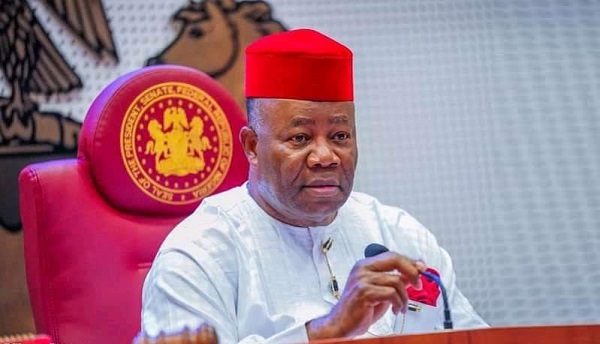
The Senate President, who was represented by the Chair, Senate Committee on the Judiciary, Human Rights and Legal Matters, Senator Adeniyi Adegbonmire, noted that a key responsibility of the parliament is to provide the legal framework that guarantees free, fair, transparent and credible elections.
Akpabio assured that the National Assembly remains committe to the continuous improvement of the country’s electoral process through legislation, oversight and constructive engagement of stakeholders.
While noting that democracy was not a destination, but a continuous journey, Akpabio said attaining electoral integrity requires sound laws, strong institutions, effective oversight and the commitment of all stakeholders to democratic values.
He stressed the need for all stakeholders to continue to cultivate a political culture that values ideology over intimidation, persuasion over violence and national interests over partisan advantage.
Akpabio said: “The future of credible elections in Nigeria will depend, not only on technology and legal reforms, but also on character, leadership and institutional trust,” adding that “nations rise when citizens believe in the fairness of their institutions.”
Falana, who recalled his involvement, along with some others, in the struggle to ensure the June 12 presidential election held, commended the late Prof for the role he played, describing him as a man of integrity and courage.
“By April 1993, we knew that General Babangida was not committed to having an election. He simply wanted to metamorphose from a military dictator to a civilian president. So we had a running battle,” Falana said.
Read Also: Ndidi, Moffi, Onuachu, Others Rue Missing Out Of World Cup
He expressed disappointment that those who are currently the direct beneficiaries of the past democratic struggles appear not to be committed to ensuring electoral integrity and providing the people with dividends of democracy.
Falana, who noted the absence basic necessities of life, expressed doubts if elections would hold next year under the current atmosphere of insecurity in the country.
He said: “If you want democracy next year at the elections, you must ensure that kidnapping, abduction of Nigerians, including children, stops.
“We can’t be talking of elections without addressing problems that will make elections impossible next year. If terrorism continues, if abduction of people continues, it will be difficult to have campaigns very soon.”
Ojukwu said the event was not merely a commemoration lecture, but a solemn reminder of the sacrifices made by courageous Nigerians in the struggle for democracy, constitutional governance, electoral justice, and the protection of fundamental human rights to participate in free and fair elections.
He explained that the collaboration between the NHRC and the Prof Nwosu Centre is founded on shared ideals and a common vision for democratic society governed by justice, accountability, inclusion, and respect for the right to participate and assemble and to vote and be voted for.
Justice Aboki noted that at a moment when citizens are demanding accountability, when technology is reshaping political participation and when democratic institutions are being tested across the world, Nigeria must confront a fundamental question: how do we strengthen the sanctity of our electoral process?
He argued that electoral integrity is not merely a technical issue; it is a human rights issue, because it is about the right of every citizen to choose their leaders freely without fear of manipulation or disenfranchisement.
The son of Prof Nwosu, Emeka Nwosu, who is the President of the Prof Nwosu Centre, which was unveiled on Tuesday, said the organisation is designed for the advancement of democratic values.