
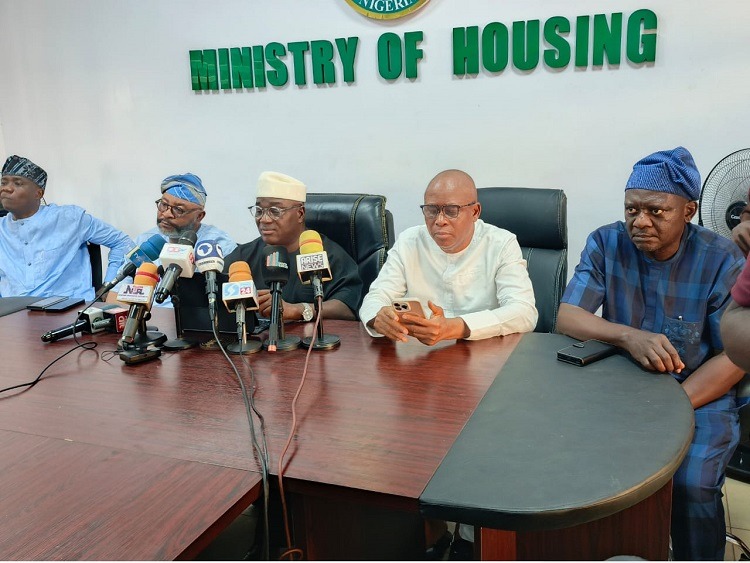
The Ogun State Government has announced plans to deliver at least 3,000 housing units in 2026, supported by a budgetary allocation exceeding N100 billion for the sector.
Commissioner for Housing, Jamiu Omoniyi, disclosed this on Monday, adding that 579 low-income housing units are expected in the second quarter of 2026, forming part of the 2,500 units earmarked for workers around Siun in Obafemi-Owode Local Government Area.
The commissioner explained that the low-income housing project will be jointly executed by the Ministry of Housing, Ogun State Housing Corporation, and the Ogun State Property and Investment Corporation.
Omoniyi highlighted the administration of Governor Dapo Abiodun’s broader housing target of 10,000 units for residents, noting that over 5,000 units have been delivered in the last six and a half years, with efforts underway to bridge the remaining gap before the administration’s term ends in May 2027.
Speaking at a briefing at the Ministry of Housing in the Governor’s Office, Oke Mosan, Abeokuta, he said, “In line with the 2026 budget projection of over N100 billion, the housing sector is poised to deliver an additional 3,000 units of affordable housing across the state, including infrastructure-supported site-and-service schemes.
“For low-income earners, we plan to replicate what we achieved at Kobape around Siun. The 2,500 affordable housing units will comprise two- and three-bedroom apartments. The first phase, beginning in the first quarter, will start with 579 units. Land has been secured, stakeholders engaged, and site clearance will commence before the end of the week, with construction kicking off before the month ends.”
The commissioner added that subsequent phases will follow after the delivery of the first phase by May or June.
Omoniyi also outlined other key legacy projects, including the construction of an International Conference Centre at the Gateway International Airport, Iperu, featuring a 2,500-seat banquet hall; the Appeal Court headquarters and residences; Ibara GRA Phase II with 50 duplexes; Commissioners’ Quarters, Appointees’ Quarters, and Assembly Quarters.
He listed ongoing flagship housing developments in strategic locations such as Prince Courts Estate at Siun along the Abeokuta–Sagamu Expressway, ISEYA Court, Oke-Mosan, Havila Court, Ibara, and Havens Court, Igbeba, Ijebu-Ode, alongside the continuation of the Ibara GRA Urban Regeneration Project Phase II.
“These initiatives are aligned with the 2026 Budget of Sustainable Legacy presented by Governor Abiodun,” Omoniyi said.
Read Also: Bashiru to Wike: You lack locus to interfere in APC Affairs
The commissioner noted that 2025 ended on a strong note with the delivery of 30 duplexes at Ibara GRA Cluster 1 Extension and 100 duplexes at the President Muhammadu Buhari Estate. He added that over 150 of more than 200 modern housing units planned for the Ibara GRA Urban Regeneration Project have already been completed, restoring structure to previously neglected areas.
Omoniyi reaffirmed that the state government’s housing investments continue to meet the growing demand for affordable, quality homes while driving slum regeneration and sustainable urban development.
“Despite criticism and misinformation last year, we remain focused on delivering affordable housing. Having delivered more units than all previous administrations combined, Ogun State is on track to complete over 10,000 homes by the end of this administration,” he said.
The announcement comes amid a national housing deficit estimated at 28 million units as of 2024, driven by rapid urbanisation and population growth. Minister of Housing and Urban Development, Arc. Ahmed Dangiwa, recently said the deficit could be addressed if about 550,000 housing units are built annually at an estimated cost of N5.5 trillion over the next decade.
Dangiwa noted that Nigeria’s population of over 200 million, growing at 2.5 per cent annually, has exacerbated housing challenges, with inadequate supply and substandard living conditions falling short of United Nations and World Health Organisation habitability standards.