
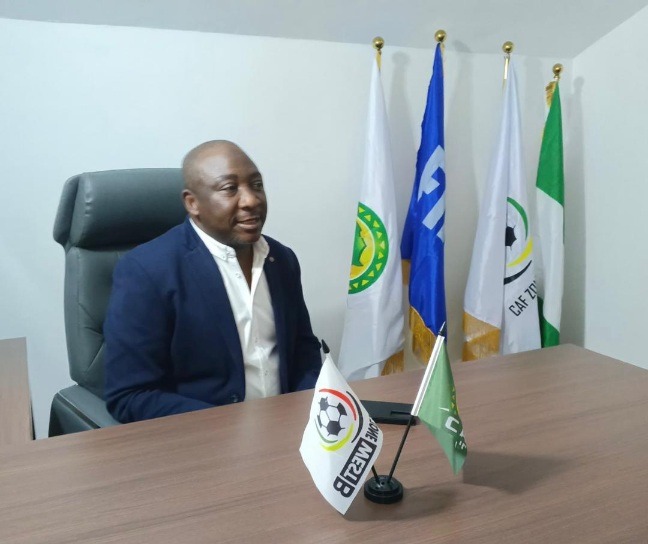
- By P.A. Abubakar
Leadership in football administration is often accompanied by criticism, pressure, and expectations from stakeholders. Across the world, football federation presidents regularly face scrutiny over team performances, administrative decisions, financial management, and governance. In Nigeria, the Nigeria Football Federation (NFF) is no exception. As President of the NFF, Alhaji Ibrahim Musa Gusau has had to navigate numerous challenges while overseeing the country’s football ecosystem.
Despite occasional calls from some quarters for his resignation, there are strong reasons to believe that Gusau is unlikely to step down before the expiration of his tenure. These reasons are rooted in constitutional provisions, administrative achievements, stakeholder support, and his long-term vision for Nigerian football.
These are the first reasons for Gusau to enjoys another legitimate electoral mandate.
He emerged as NFF President through a duly conducted election in 2022 in accordance with the federation’s statutes. Like every elected leader, his mandate is expected to run its constitutional course unless there is a legal or constitutional basis for removal. In democratic institutions, elected officials are expected to complete their tenure, allowing members to assess their performance at the next election rather than through pressure or speculation.
Secondly, the NFF has continued to maintain institutional stability under his leadership.
Before Gusau assumed office, Nigerian football experienced periods of uncertainty arising from administrative disagreements and governance disputes.
Read Also: Olopade charges Team Nigeria to compete with courage ahead of Commonwealth Games
Since taking over, there has been greater emphasis on dialogue with stakeholders, improved cooperation with government agencies, and stronger engagement with international football bodies such as FIFA and CAF. Stability remains an important achievement for any football administration.
Another reason Gusau should remain in office, is the confidence reposed in him by the NFF Congress, the federation’s highest decision-making body.
The Congress has, on several occasions, expressed support for his leadership and endorsed the direction of his administration. Such institutional backing strengthens his legitimacy. As long as the body that elected him continues to support his administration, there is little incentive for him to vacate office.
His administration has also recorded notable achievements across various levels of Nigerian football.
Under his watch, the Super Eagles have remained competitive internationally and recorded the highest ranking ever, since 2009. The Super Falcons continue to rank among Africa’s leading women’s football teams. Youth football development has also received renewed attention through grassroots programmes, talent identification initiatives, coaching education, and referee development.
Although challenges may arise, but many stakeholders acknowledge that progress has been made in rebuilding football structures.
Women’s football has equally enjoyed increased visibility during Gusau’s tenure.
The Nigeria Women Football League (NWFL) has continued to witness reforms aimed at improving competition standards and expanding commercial opportunities. Greater attention has also been given to youth women’s competitions and pathways for emerging female footballers. These initiatives reflect an administration seeking long-term development rather than short-term publicity.
Financial management is another factor. Running the NFF is not without financial constraints, yet Gusau has repeatedly emphasised prudent management of available resources.
His background as an accountant has influenced his administrative style, focusing on accountability, budget discipline, and strategic partnerships.
While funding challenges continue to affect Nigerian football, they are structural issues that predate his administration rather than problems created solely under his leadership.
Furthermore, Gusau has consistently demonstrated a willingness to engage with stakeholders instead of avoiding criticism. Football administrators inevitably face opposition, especially in a country as passionate about football as Nigeria.
Though there maybe disagreements, but that alone do not justify anyone to throw in the towel. Effective leadership often requires resilience, consultation, and continuous reforms rather than abandoning responsibility whenever criticism arises.
The support of FIFA and CAF also plays an important role. Both organisations strongly encourage stability and constitutional governance within member associations. Unless there is evidence of serious misconduct or statutory violations, international football bodies generally recognise elected executives until the completion of their mandates. This international governance framework further supports the continuity of Gusau’s administration.
Grassroots football development remains one of the hallmarks of his leadership philosophy. Gusau has repeatedly advocated for stronger investment in youth competitions, coaching programmes, referee education, and state football associations.
He has argued that Nigeria’s future football success depends on identifying and nurturing young talents rather than relying solely on established stars abroad. Such long-term programmes led to the construction of a new FIFA Goal project facilities in Abuja.
These gigantic structures comprises of a 50 rooms three stars hotel, for this to come to fruition, there is a need for continuity, making the continued stay of Gusau a possible option.
The domestic league structure has also received renewed attention. Efforts to strengthen the Nigeria Premier Football League (NPFL), Nigeria National League (NNL), Nationwide League One (NLO), and Nigeria Women Football League (NWFL) demonstrate a commitment to building a sustainable football ecosystem. While many reforms are still ongoing, their success depends on consistent leadership and institutional continuity.
Football development plans typically span several years and involve collaboration with government, sponsors, FIFA, CAF, clubs, and technical committees. Leaving office midway through implementation could slow or even reverse reforms that are already underway. For this reason, many administrators prefer completing their tenure before presenting themselves for evaluation.
Another consideration is personal leadership philosophy.
Throughout his public engagements, Gusau has projected himself as a leader committed to service rather than personal recognition.
His speeches frequently emphasise unity, patience, dialogue, and long-term planning. Such an outlook suggests that he is more inclined to complete his constitutional mandate than to yield to external pressure.
It is also important to recognise that football administration should be assessed on measurable outcomes rather than emotions. Supporters naturally judge administrators based on the performances of national teams, but football governance extends beyond match results. Infrastructure development, financial sustainability, grassroots programmes, coaching education, league reforms, and institutional governance all contribute to the overall health of the game.
Evaluating an administration requires consideration of these broader responsibilities.
Ultimately, whether one supports or criticises Gusau’s leadership, the appropriate mechanism for leadership change within the NFF remains the federation’s constitutional process. If stakeholders desire new leadership, the opportunity exists through future elections which is constitutional justification. September 2026 is an appropriate time for any aspirant to try his popularity alongside Ibrahim Gusau.
In conclusion, Ibrahim Musa Gusau unlikely to resign as President of the Nigeria Football Federation because he possesses a valid electoral mandate, continues and to enjoy institutional support, is overseeing ongoing reforms, and remains committed to completing his vision for Nigerian football.
(P. A. Abubakar is the North East Coordinator of 4+ 4 Solidarity Forum)